Proactive Governance Academy.
Board and committee paper writing training
You submit your draft board or committee paper to your executive for review. By the time it reaches your board, you barely recognise it.
Stop wasting board and committee time on unclear papers.
Your people go from guessing what good looks like to a clear method that gives them a stronger first draft in less time, and helps build their credibility with your executives and the board.
Practical, hands-on training for the people who write your board and committee papers. Built around the feedback from your directors and executives, and taught by a governance professional with 20+ years inside boards and committees: writing the papers, reviewing them as a company secretary, and in the room with the board when they are discussed.
Tell me about your papers
Tell me a little and I’ll be in touch. No pitch, no pressure.
Your details stay with Rebecca. No spam, ever.
Prefer to email? [email protected]
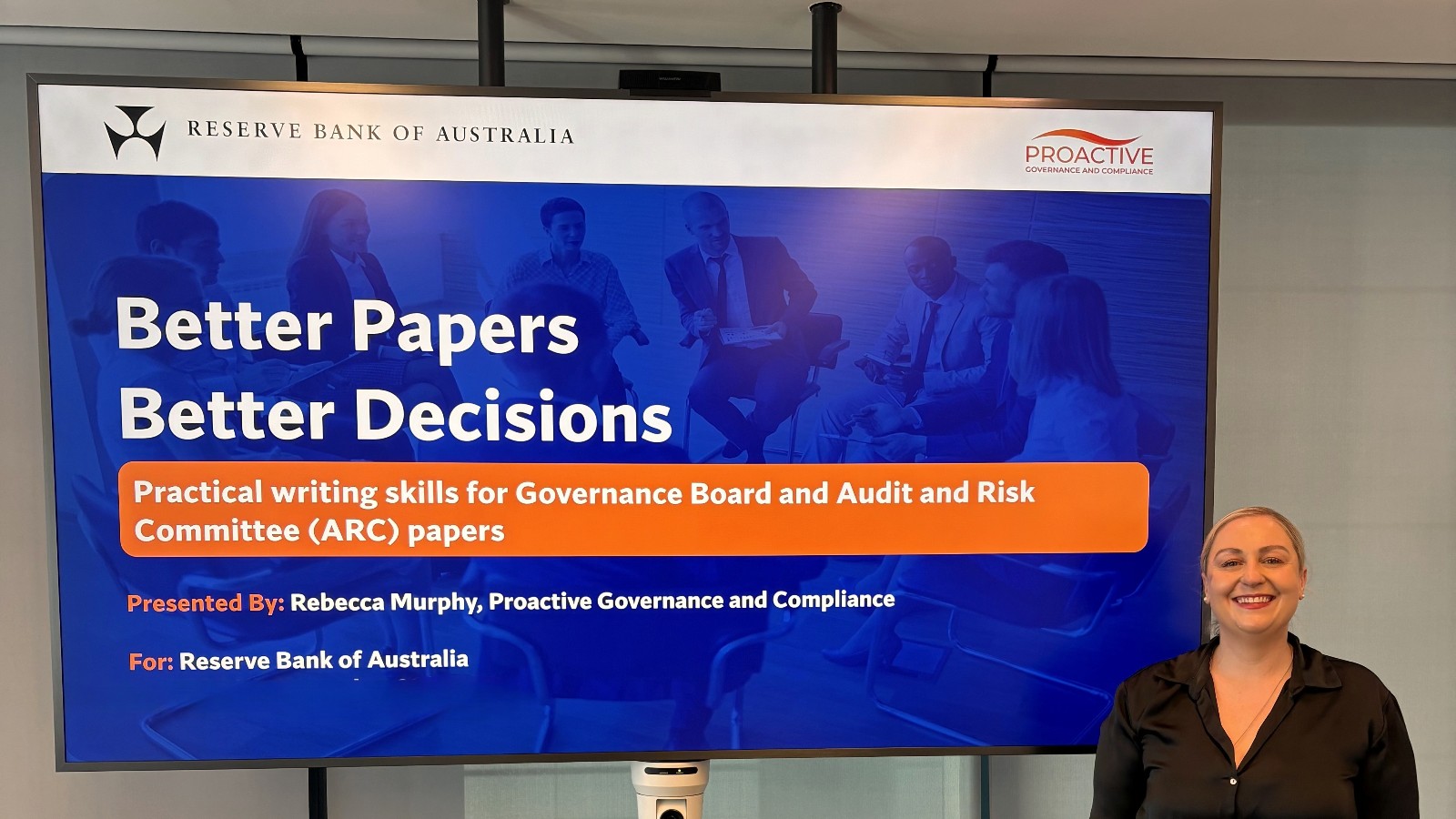
Delivered to Governance Board and Audit and Risk Committee paper writers at the Reserve Bank of Australia
· Built around your directors’ and executives’ feedback
· 20+ years inside boards and committees
Rebecca Murphy GAICD, FGIA · Graduate of the Australian Institute of Company Directors · Fellow of the Governance Institute of Australia
How I work
I run a limited number of these each quarter, because it’s me delivering every one of them. I’ve developed a framework, and I shape it around your directors’ and executives’ feedback and your key pain points, so the time goes where your papers need it most. Getting that right takes some time, so the earlier we talk, the better.
Where the papers fall down
You know the papers could be better.
Your directors and executives have given the feedback, maybe more than once. The papers are too long. The key messages are not clear. There are pages of operational detail, and still not the information they need to make the decision. The ask is buried three pages in.
So your executives end up rewriting papers, sometimes almost completely, and your secretariat is lifting every paper at the last minute. Everyone is working hard. The papers still are not landing.
Your people are capable professionals who were never shown what good looks like. They are working from a template and some guidance, with no benchmark to write to, and none of the practical tools and techniques to plan, write and sharpen a paper. That is exactly what I teach.
Why this matters
68%
of organisations rate their board materials as weak or poor
1%
rate their board materials as excellent
57%
of directors say finding the key messages is like looking for a needle in a haystack
Source: Board Intelligence and the Chartered Governance Institute, The State of Board Effectiveness.
When a paper is clear, the discussion starts where it should, and the meeting’s time goes on the deliberations and the decision.
Clear papers are good governance.
The shift
Know what good looks like.
The benchmark most paper writers were never given, and the practical tools and techniques to get there. Once your people can see what good looks like, and have the tools to do it, they have everything they need to write clearer, sharper papers.
What it is, and why it’s different
A practical framework, shaped by your board and committee’s feedback.
I teach a practical framework that covers the whole life of a board and committee paper: knowing what good looks like, planning before you write, writing it clear and tight, and reviewing it before it goes up.
I built it over 20+ years of doing the job: writing board and committee papers, having my own reviewed and rewritten, hearing directors’ feedback, and running into the same challenges your people do. Then I shape it around your board and committee’s feedback, your key pain points, and where it will make the biggest difference.
What your people walk away with
Practical tools and techniques to plan, structure and develop clearer, more concise papers that support effective decision-making.
From guessing at what good looks like, to a repeatable method they can use on their very next paper.
By the end, your people will be able to:
01
Know what good (and bad) looks like
See what good and bad look like through worked examples, with the thematic feedback your directors actually give, so your people stop guessing and start seeing it for themselves.
02
Plan before they write
With practical tools they can implement. A little time up front saves a lot later, and it is the step most people skip.
03
Write clearer, more concise papers
That highlight what matters quickly and support the decision.
04
Sharpen and self-edit
Practical ways to lift and pressure-test a paper before it goes up, and how to ask for and use feedback well.
The result: they plan and draft in less time, with a stronger first draft and better papers from the very first review, the kind that build credibility with your executives and the board. And they can use it on their very next paper.
What’s included, how a program runs
Super practical, set in your own templates, focused on your key pain points and the tools to fix them.
Every program starts with your board and committee’s feedback and the key pain points on what’s not working. From there:
✓A practical exercise set in your own template, working through a low-quality paper.
✓A second exercise built around a high-quality paper, one of yours or one I provide.
✓The core framework: practical planning, writing, reviewing and editing tools they can apply to their very next paper.
✓Everyone takes home a practical handbook.

How it works
A simple path, shaped around your papers.
1
We talk
I listen to your key pain points and what your directors, executives and secretariat say is not working.
2
I shape the program
I bring the core framework, the planning, writing and reviewing tools and techniques, and shape it around your key pain points, so the time goes where your papers need it most.
3
They attend and apply
Hands-on exercises during the session, and practical tools and tips they can use in their very next paper.
Optional add-on: a follow-up Q and A session
In the session, the tools come to life through hands-on exercises and board paper activities. From there it builds: your people put them to work on their own board and committee papers, getting sharper with every one they write.
Who it is for
Built for the people who write your board and committee papers.
The core audience
Your paper writers
Your managers, senior managers, heads of department and staff who write and contribute to your board and committee papers on behalf of your executives. This is who the program is designed for, and where the time goes.
Executives are welcome too
When they sit in and participate, it sets a strong tone from the top. The people who review papers hear the same guidance as the people who write them, so when the shift starts showing up in the papers, they recognise it. Executives joining is a bonus, not the focus.
An added benefit
It reaches wider than the boardroom: the same tools and techniques carry across to your internal management committee papers, and everyday business writing too.
“Very practical, and it can be applied immediately across many settings.”
Three things worth knowing
The questions people usually ask first.
01 Will it be tailored to us?
Yes. It is built around your board and committee’s feedback and your key pain points, with some of the exercises set in your own template. I bring the framework I have built over 20+ years; you bring your papers and what your directors want to see. That is where we spend the time.
02 Is it worth the spend?
Your people get practical tools, techniques and skills they will use from their very next paper, and it saves your senior people the time and rework they are putting in now. And it is not just board and committee papers: they can apply the same skills to your internal management committee papers too, so the benefit carries across your papers more broadly.
03 Why does it work?
Because the sessions are practical and personal. They are hands-on, with lots of examples and activities in the room. The focus comes from what your directors, executives and secretariat have already said: we pick the key pain points, the things that will make the biggest difference. And it is taught by someone who has done the job: 20+ years of writing board and committee papers, reviewing them, and sitting in the room when they are discussed.
In their words
From the people who sat in the room.
“My approach will be completely different.”
Senior Manager, Strategy
“I now have a much better idea of what good is. Clear purpose, clear call to action.”
Senior Manager, Risk
“Lots of great tools and techniques I can use right away.”
Manager, People and Culture
“An excellent presenter, engaging and knowledgeable.”
Manager, Governance
“I’m more equipped now, the structure and purpose of a paper are clear.”
Senior Manager, Finance
“Rebecca really gets the frustrations we have with board and committee papers. She shared practical tools and tips, and examples from her own time as a company secretary, to help us move past them.”
Senior Manager, IT
Why Rebecca
Most people see a board paper from one seat. I’ve worked from four.
I am Rebecca Murphy, a governance professional with 20+ years across financial services, government and higher education. I have been a Company Secretary, Chief Governance Officer, Head of Governance, and adviser to boards, committees and executive teams. I run governance reviews, and I have been on the receiving end of their recommendations too.
I have written the papers, and reviewed thousands of them as a company secretary, including across the governance reviews I run, so I know what directors need to see. I have sat in the room watching directors work through them: asking probing questions, asking for more or less, and drawing out the insight themselves when it was missing. And I have coached writers and executives through their papers, one at a time.
I teach in plain English, from lived experience, not a textbook.

Selected engagements
A sense of the work behind the training.
The Star · Governance remediation
As part of the Governance Remediation Program, in a period of significant transformation and under tight time frames, embedding a new governance framework and working hands-on with executives and paper writers: observing board and committee meetings, reviewing and refining papers, giving feedback, and redesigning templates and the guidance around them, so the quality of the papers, the clarity of the ask and the so what kept improving, meeting after meeting.
Bank of Queensland · Committee governance review
As part of an APRA-endorsed Remediation Action Plan, a governance review of seven management committees: their structures, decision-making, escalation pathways and the information flowing to the board, then partnering with the bank to implement the priority recommendations, including new committee charters and governance documentation. The redesigned structure and roadmap were submitted to APRA and passed by the independent assessor.
Reserve Bank of Australia · Board paper writing training
Designed and delivered a board and committee paper writing program for the writers supporting the Governance Board and the Audit and Risk Committee: five practical workshops, built from their directors’ feedback, with immediately usable tools to write shorter, clearer, more decision-ready papers.
Rabobank · Board reviews and governance uplift
Two bespoke board effectiveness reviews for the Australian and New Zealand boards, then a governance improvement program across 19 committees: a redesigned board paper template, governance principles and standards, and enhanced board and committee charters. Partnered with the CEOs and executives in both countries to implement the priority recommendations.
Let’s talk
Want better papers in front of your board and committees?
Let’s have a conversation about your papers and the feedback from your directors, executives and secretariat. No pitch, no pressure.
Tell me about your papers
Tell me a little and I’ll be in touch. No pitch, no pressure.
Your details stay with Rebecca. No spam, ever.
Prefer to email? [email protected]
The occasional note
Stay in the loop.
The occasional note on what’s coming up at Proactive Governance Academy, plus a practical tip or two on sharper board and committee papers.
No spam. Unsubscribe anytime.
Governance made practical.
Rebecca Murphy GAICD, FGIA · Founder, Proactive Governance Academy
Graduate of the Australian Institute of Company Directors · Fellow of the Governance Institute of Australia
© Proactive Governance 2026